Software your whole team can see — and your AI can safely change
Graphden keeps your program as a living, typed graph in a database — not text in files. Engineers review structure instead of prose diffs, teammates compose ready-made typed blocks without touching code, and AI edits land as inspectable, effect-gated changes. And it's already running: no build step, no deploy step.
The demo drops you into a live, sandboxed workspace that self-destructs after an hour — an interactive lesson walks you through your first function. This page is itself a graphden graph, served by the platform it describes.
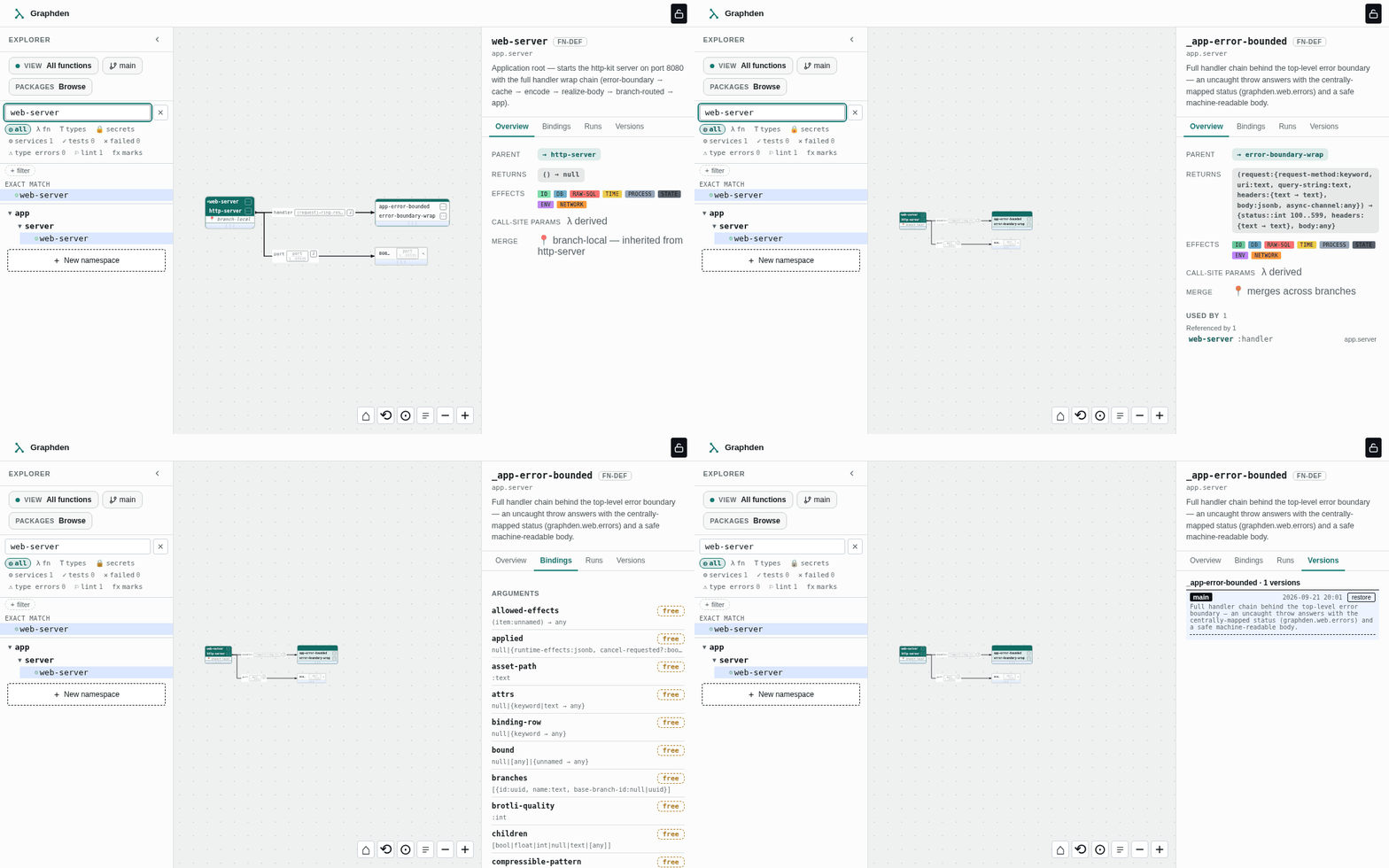
What a function looks like
{:name :my-about-page
 :parent :html-page-route
 :args {:path "/about"
        :title "About"
        :body :my-about-body       ; returns hiccup
        :head :graphden-page-head  ; default CSS
:scripts {:value []}}} ; no JS- A row, not a file.
:parentpicks the template;:argsbind its slots. The unbound ones stay free — the Run form asks for them. - Type-checked as you bind.
:bodymust return hiccup,:pathmust be a path; a wrong wire is refused in the editor, not at 3 a.m. - Already deployed. Save it and the route answers. Branch it, diff it (above), merge it — the same way you'd review anything else.
Paste it into the editor, or follow lesson 10 where it comes from.
One change — two ways to review it
In text: nine lines touched, the change buried in rewrapping
- export const notify = (channel, msg) =>- post(channel, render(msg))+ export const notify = (+ channel = ONCALL_CHANNEL,+ msg,+ urgent = true+ ) =>+ post(channel,+ urgent ? renderUrgent(msg) : render(msg))
In Graphden: the structure that actually changed
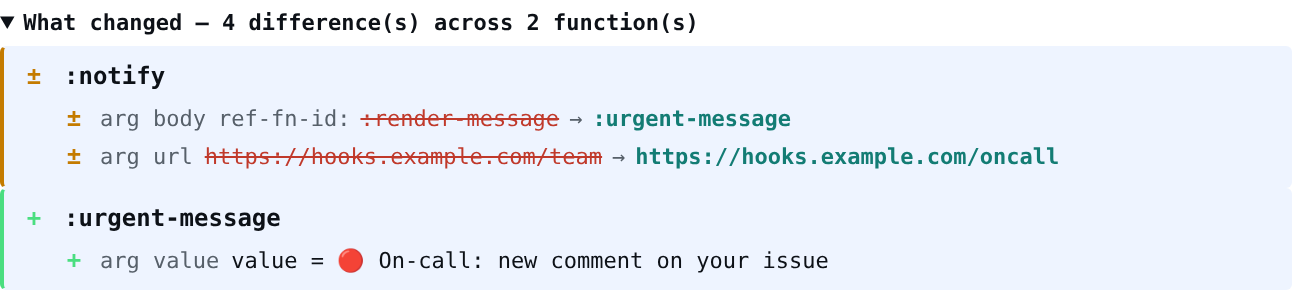
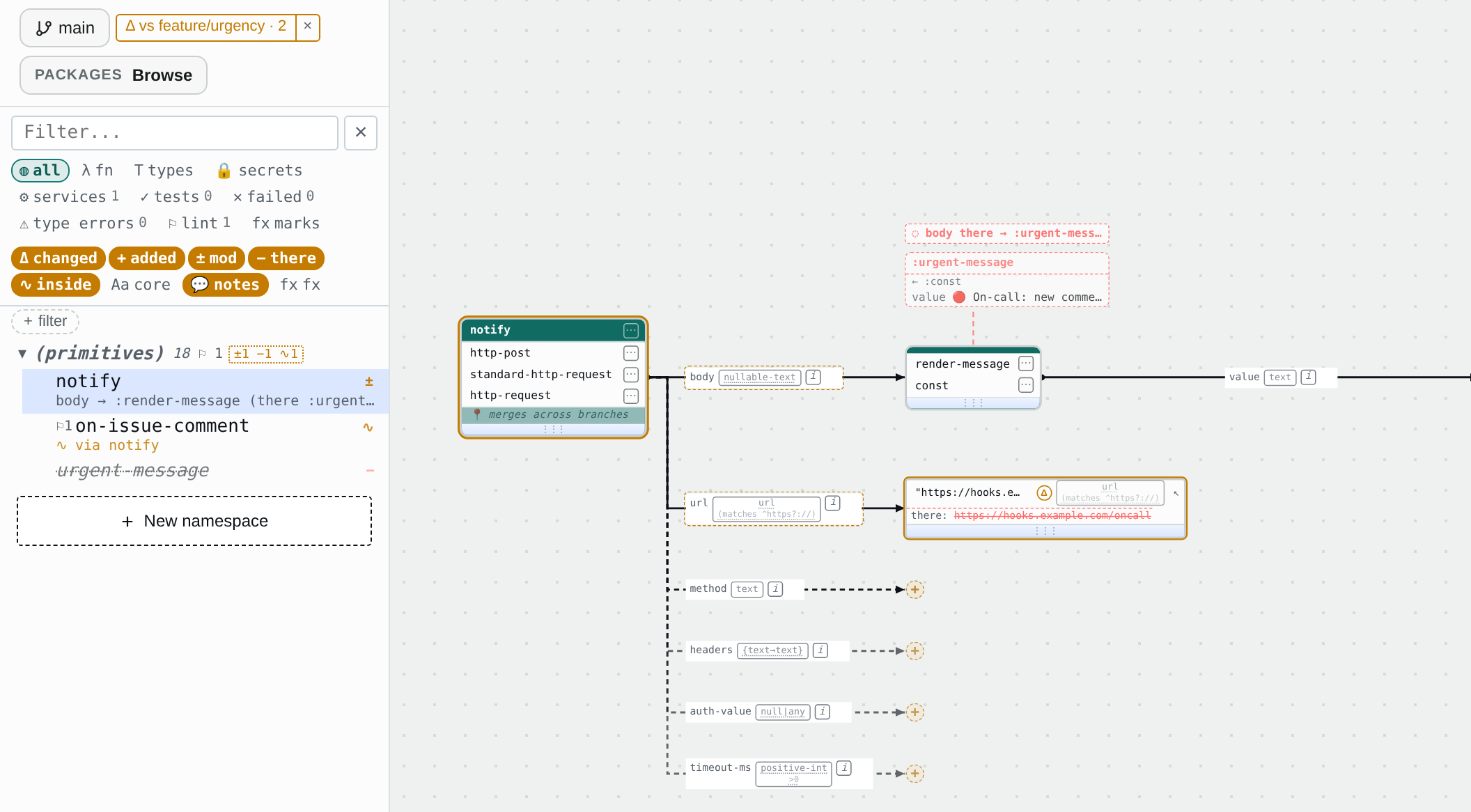
Same edit, as the editor renders it: each rebinding as old → new, the new function by name, its seeded value — whether a human made it or an AI did. Flip on compare mode and the diff becomes the graph: the value the branch holds sits under yours, the function it swapped in hangs beside the card as a ghost of its own subtree, and everything that merely depends on the change is marked changed-inside. Click either shot for full size.
One graph, three ways to work on it
Engineers review structure, not prose
Every function is a row; composition is edges. The whole program is queryable, versionable and branchable — like git, except it stays alive while you edit it. A change lands as a structural diff — added N functions, changed M bindings — so review reads the behaviour, not reformatted text.
Teammates compose without code
Ready-made typed blocks wire together by shape, and every connection is type-checked as you make it — so a support engineer or a manager can extend a workflow without being able to break it. Secrets are taint-tracked through composition and redacted at the edges.
AI edits it can't silently break
An AI proposal is a graph change: typed, effect-declared (db, network, process — gated at runtime), structurally valid by construction. You inspect exactly what it did in the same editor you build in — behaviour, not 400 lines of reformatted text.
How it works
New here? The tutorial walks the whole path in 36 short lessons — first function to types, branches, tests and a running service.
Pricingcloud
| Capability | Demo | Free | Cloud Shared | Cloud Dedicated |
|---|---|---|---|---|
| Price | none — no sign-up | 0 | €15 / organisation / month | €90 / month |
| Outbound HTTP / your own DB / bots | — | ✓ metered | ✓ | ✓ |
| Functions | 200 | 500 | 5,000 | 5,000 |
| List items | 2,000 | 50,000 | 500,000 | 500,000 |
| Outbound calls / min | 0 | 120 | 6,000 | uncapped |
| Always-on services | — | — | — | ✓ dedicated pod |
| Bring your own executor | — | — | ✓ | ✓ |
| Workspace | 1-hour sandbox | persistent while used* | persistent | persistent |
* A free organisation nobody signs into, runs or edits for 60 days is scheduled for deletion, with an email 14 days ahead and a reminder 2 days before; any sign-in cancels it. Paid organisations are never scheduled.
Paid plans are in founding-user beta: the first 30 organisations get Cloud Shared or Cloud Dedicated free until billing launches, then six months at half price — in exchange for feedback. Ask for a plan with your organisation name. Self-hosting is free and uncapped, always. Organisations that cannot accept the AGPL can take a commercial licence for the core.
Self-host it
One binary, AGPL
The cloud runs the exact same open-source core you can run yourself — multi-tenancy is an optional addon, not a fork. Postgres is the only dependency.
Quick start
git clone https://github.com/Graphden/graphden
cd graphden
bb rebuild        # jar + docker + start
open http://localhost:9002
Work with the author
Graphden is built by one engineer who also builds on it. If you would rather have the result than the tool, the same person does the work — on your cloud organisation or your own server.
Pilot: from €1,500
An integration, an automation or an internal service built in your graph in two to four weeks, fixed price agreed up front. You keep everything; it runs on the open core.
Self-host support: €300 / month
Next-business-day answers, help with upgrades and migrations, incident diagnosis, a monthly check-in. Up to four hours a month, more at the hourly rate.
Hourly: €60–80
Anything smaller, and the published rate for contributor work funded through the project's Open Collective.
Write to hello@graphden.dev with two sentences about what you need. Details: SUPPORT.md.
Support the project
Graphden is built in the open by one engineer, with AI as an accelerator and every change reviewed by a human. If it's useful to you, star it, break it, tell us — or fuel the servers:
…or send crypto directly (self-custodied):
bc1qqp3etkkceygs9n8vvhuwm6fc4u56ceflr6e6nu0x5D3c2E2272F0b7244184Cb3231b6f21D8a1c97fDTShPHXzRBuneddGfSK9DXtPV6BEAghrbbE